Tax Planning for Q2: What Businesses & Professionals Should Review Before 30 September
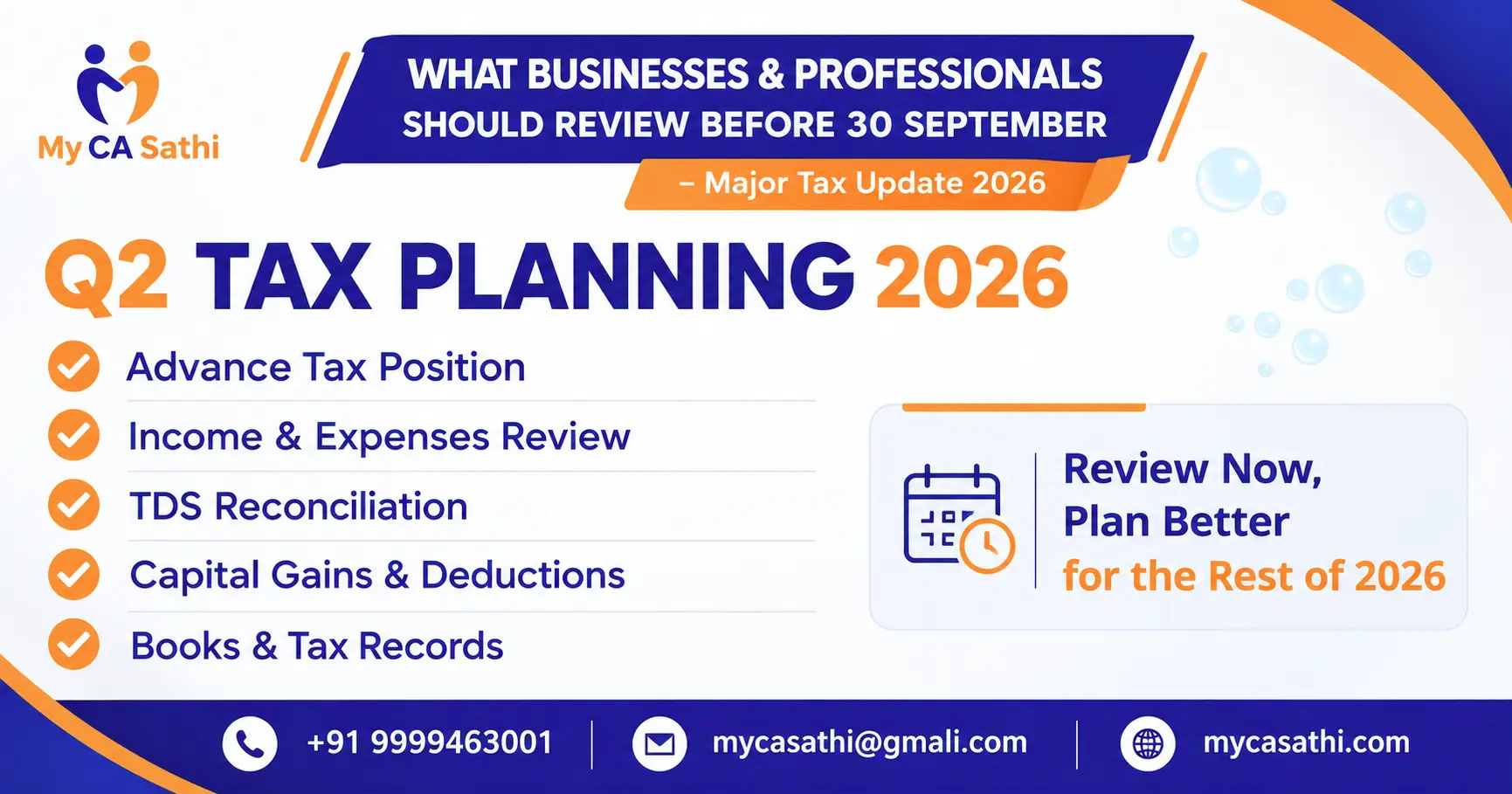
The end of September marks the close of the second quarter of Tax Year 2026-27. It is a useful time for businesses, freelancers and professionals to review their income, expenses, taxes paid and expected tax liability before the financial year progresses further.
For Tax Year 2026-27, the Income Tax Act, 2025 applies to income earned from 1 April 2026 onwards. The new law uses the term “Tax Year” instead of the earlier “Assessment Year” terminology.
Q2 tax planning is not about waiting until March to calculate tax. A review in September can help taxpayers identify changes in income, estimate their annual tax liability and organise records well in advance.
This guide explains the key areas that businesses and professionals should review before 30 September 2026.
Why Tax Planning Before 30 September Matters
Income and expenses can change significantly during the year.
For example:
- Business turnover may increase
- Professional receipts may change
- New clients may be added
- Expenses may rise or fall
- Investment income may be received
- Capital assets may be sold
- TDS may not fully cover the expected tax liability
- Advance tax may need to be reassessed
A September review provides an opportunity to compare actual results with the original annual estimate.
The Income Tax Department provides an online Income and Tax Estimator that can be used for Tax Year 2026-27 to estimate tax based on income, deductions and other details.
1. Review Your Income for Q2
The first step is to review income earned during April to September.
For businesses, review:
- Sales/turnover
- Service revenue
- Other operating income
- Interest income
- Rental income
- Other business receipts
For professionals, review:
- Professional fees
- Consultancy income
- Retainer income
- Freelance receipts
- Other professional receipts
Compare actual income with the estimate made at the beginning of the year.
Ask:
Is your annual income likely to be higher or lower than originally estimated?
If there is a significant change, your tax estimate may also need to be revised.
2. Recalculate Your Expected Annual Tax Liability
After reviewing income, estimate the likely income for the full Tax Year 2026-27.
A simple approach is:
**Actual Q1 + Q2 income
- Expected Q3 income
- Expected Q4 income
= Estimated annual income**
Then consider applicable deductions, exemptions, losses and other tax adjustments.
The Income Tax Department's tax estimator allows taxpayers to calculate estimated tax under the applicable provisions and compare tax treatment where relevant.
3. Review Advance Tax Position
Advance tax should be reviewed as part of Q2 tax planning.
Under the new Income Tax Act, 2025, advance tax is payable when the tax payable during the year is ₹10,000 or more. The threshold remains unchanged from the earlier provisions.
For Tax Year 2026-27, the advance-tax instalment structure includes:
- Up to 15 June — at least 15%
- Up to 15 September — at least 45%
- Up to 15 December — at least 75%
- Up to 15 March — 100%
The September instalment is therefore an important checkpoint for reviewing whether the tax paid so far broadly corresponds with the estimated annual liability.
Since 15 September has already passed, businesses and professionals should now review whether their advance-tax position needs attention for the remaining instalments.
4. Check TDS Already Deducted
Tax planning should consider TDS already deducted from your income.
Businesses and professionals should review:
- TDS deducted by clients
- TDS deducted by banks
- TDS on rent, where applicable
- TDS on professional receipts
- TDS on other income
- TDS reflected in available tax records
Compare:
Estimated annual tax liability – TDS already deducted = Approximate remaining tax requirement
This can provide a better basis for reviewing the remaining advance-tax liability.
5. Review Business Expenses
Businesses should review expenses incurred during the first half of the year.
Common areas include:
- Employee salaries
- Rent
- Professional fees
- Advertising and marketing
- Software subscriptions
- Travel
- Repairs and maintenance
- Office expenses
- Interest and finance costs
- Depreciation
- Business insurance
The objective is not simply to increase expenses. Businesses should ensure that genuine business expenses are properly recorded and supported by relevant documents.
6. Check Outstanding Receivables
Tax planning should also consider outstanding customer payments.
Prepare an ageing report showing:
- Current receivables
- 30–60 days
- 60–90 days
- More than 90 days
This helps businesses understand their cash-flow position.
However, businesses should distinguish between accounting recognition of income and actual cash collection. Tax treatment does not automatically change merely because a customer has not paid.
7. Review Business Profitability
Revenue alone does not provide a complete picture of tax liability.
Compare:
Revenue → Gross Profit → Operating Expenses → Net Profit
Review whether profit margins have changed compared with the previous year.
For example:
Revenue increased by 25%, but expenses increased by only 10%.
Such a change may significantly affect estimated taxable income and future tax payments.
8. Professionals Should Review Professional Receipts
Doctors, lawyers, consultants, architects, CAs, designers, freelancers and other professionals should maintain an updated record of professional receipts.
Review:
- Client-wise receipts
- TDS deducted
- Outstanding invoices
- Retainer income
- Online platform income
- Cash/bank receipts
- Other professional income
Professionals should also ensure that their books and supporting records are updated consistently.
9. Review Presumptive Taxation Where Applicable
Eligible small businesses and professionals may consider whether presumptive taxation provisions are applicable to their circumstances.
The Income Tax Department's guidance describes presumptive taxation provisions for eligible residents carrying on certain businesses or professions.
For Tax Year 2026-27, taxpayers should review the applicable provisions under the Income Tax Act, 2025 rather than relying only on older section references.
This is particularly important when preparing tax estimates or comparing regular and presumptive methods.
10. Review Capital Gains
Businesses and professionals who have sold investments or other capital assets during the year should review potential capital gains.
Check:
- Shares
- Mutual funds
- Property
- Other investments
- Sale consideration
- Cost of acquisition
- Eligible expenses
- Short-term/long-term classification
- Capital losses
Capital gains can materially change the annual tax estimate.
Therefore, any significant sale during April–September should be included in the Q2 tax review.
11. Review Investments and Eligible Deductions
Taxpayers should review whether any deductions or tax-saving investments are relevant to their tax position.
Depending on the applicable tax regime and eligibility, review items such as:
- Eligible investments
- Insurance-related deductions
- Certain health-related deductions
- Housing-related deductions
- Education loan interest
- Other eligible deductions
Do not make an investment solely for tax-saving purposes without checking whether the deduction is actually available under the applicable tax regime.
12. Review Your Tax Regime
Taxpayers should review the tax regime applicable to their circumstances and estimate their tax accordingly.
The Income Tax Department's tax calculator allows comparison of tax under the available regimes where applicable.
For businesses and professionals, the appropriate tax treatment can depend on the taxpayer's category, income structure and applicable provisions.
A September review gives taxpayers time to identify whether their current tax planning assumptions remain appropriate.
13. Review GST and Income Tax Data Together
Businesses should not analyse income tax separately from their business records.
Compare relevant figures from:
Books of Accounts → GST Returns → Income Tax Records
Review differences in:
- Sales
- Turnover
- Credit/debit notes
- Expenses
- Purchases
- Other income
A difference does not automatically mean there is an error because different tax laws can have different reporting treatments. However, significant differences should be understood and properly documented.
14. Review TDS Compliance
Businesses that deduct TDS should review their TDS records as part of Q2 tax planning.
Check:
- TDS deducted
- TDS deposited
- Challans
- Deductee details
- Quarterly TDS data
- Outstanding defaults
- TDS certificates
This is particularly important where a business has made significant payments to contractors, professionals, landlords or other vendors.
15. Review Books of Accounts
By the end of September, businesses should ideally have their books updated through at least August and preferably September on a near-real-time basis.
Review:
- Sales
- Purchases
- Expenses
- Bank entries
- Receivables
- Payables
- Loans
- Fixed assets
- GST balances
- TDS balances
Updated books provide a much more reliable basis for tax planning.
16. Check Bank and Cash Transactions
Reconcile business bank accounts with the books.
Look for:
- Unrecorded receipts
- Unrecorded payments
- Bank charges
- Interest income
- Loan transactions
- Transfers
- Unexplained entries
Cash transactions should also be reviewed for proper recording and compliance.
17. Review Loans and Interest Expenses
Businesses with loans should review:
- Principal outstanding
- Interest paid
- Interest accrued
- New loans
- Repayments
- Related-party borrowings, where applicable
Correct classification of principal and interest is important for maintaining accurate accounts and tax records.
18. Review Fixed Assets and Depreciation
If the business purchased machinery, computers, furniture, vehicles or other assets during the first half of the year, update the fixed asset register.
Check:
- Purchase date
- Asset cost
- Capitalisation
- Disposal
- Depreciation
- Supporting invoices
This can help ensure that the annual tax estimate is based on reasonably complete financial information.
19. Check Previous Tax Demands or Outstanding Dues
Businesses and professionals should also check the income-tax portal for outstanding demands or unresolved compliance issues.
Review:
- Outstanding tax demand
- Notices
- Refund issues
- Previous return discrepancies
- Pending responses
- Tax payment history
Ignoring an old tax demand while planning current-year taxes can create avoidable cash-flow issues.
20. Maintain Proper Tax Documents
Tax planning is easier when documents are organised throughout the year.
Maintain:
- Sales invoices
- Purchase invoices
- Expense bills
- Bank statements
- Investment statements
- TDS certificates
- GST returns
- Loan statements
- Asset purchase documents
- Capital-gain statements
- Tax-payment challans
Good documentation also makes year-end tax preparation easier.
Q2 Tax Planning Checklist Before 30 September 2026
Businesses and professionals can use this quick checklist:
☑ Review April–September income
☑ Estimate full-year income
☑ Recalculate expected tax liability
☑ Review advance-tax position
☑ Check TDS already deducted
☑ Review business/professional expenses
☑ Reconcile bank accounts
☑ Review receivables and payables
☑ Check capital gains
☑ Review eligible deductions
☑ Review applicable tax regime
☑ Reconcile GST and books
☑ Review TDS compliance
☑ Update books of accounts
☑ Review fixed assets and depreciation
☑ Check outstanding tax demands
☑ Organise tax documents
☑ Plan for December advance-tax instalment
Common Tax Planning Mistakes to Avoid
1. Waiting Until March
Tax planning should not be postponed until the end of the financial year.
2. Ignoring TDS
TDS already deducted should be considered when estimating the remaining tax liability.
3. Using Outdated Income Estimates
If income has increased significantly, the original tax estimate may no longer be accurate.
4. Ignoring Capital Gains
Investment or property sales can materially affect the tax calculation.
5. Poor Bookkeeping
Incomplete books make it difficult to calculate a reliable tax estimate.
6. Mixing Business and Personal Expenses
Maintain clear records and proper classification of business transactions.
7. Making Investments Without Checking Eligibility
A payment or investment does not automatically qualify for a tax deduction.
8. Ignoring the New Tax Framework
For Tax Year 2026-27 onwards, taxpayers need to use the applicable provisions of the Income Tax Act, 2025.
How Businesses and Professionals Can Plan Better for Q3 and Q4
After completing the September review, create an updated tax projection for the remaining six months.
October–November
Monitor:
- Revenue
- Expenses
- TDS
- Capital gains
- GST
- Cash flow
December
Review the next advance-tax instalment based on the updated annual estimate.
January–March
Start final tax planning, documentation and year-end accounting well before March.
This rolling approach can be more effective than preparing the entire tax calculation at year-end.
Final Takeaway
30 September is a useful tax-planning checkpoint for businesses and professionals.
A proper Q2 review should cover income, expenses, advance tax, TDS, capital gains, deductions, books of accounts and outstanding tax matters.
For Tax Year 2026-27, businesses and professionals should also ensure that their tax planning and payment processes are aligned with the Income Tax Act, 2025. The Income Tax Department confirms that advance tax for Tax Year 2026-27 is governed by the new Act, while the basic advance-tax threshold remains ₹10,000.
Rather than waiting until March, use the September review to update your annual tax estimate and prepare for the remaining tax instalments.
Key Takeaways
- GST registration requirements depend on turnover and nature of business.
- Timely filing helps avoid unnecessary interest and late fees.
- Businesses should maintain proper invoices and supporting documents.
Important Note
Tax rules and compliance requirements may change from time to time. Always verify the applicable provisions before taking any action.