September 2026 Tax Compliance Checklist: What to Do After 15 September
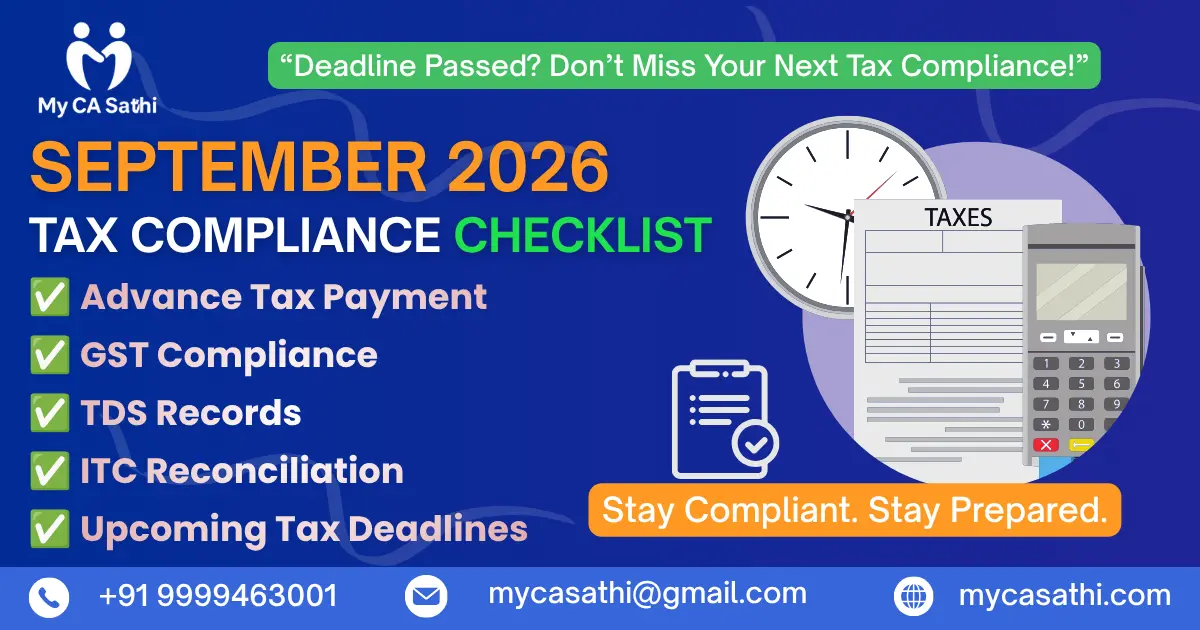
September is an important month for taxpayers and businesses because it includes the second instalment of advance tax as well as regular GST and TDS compliance activities. Now that the 15 September 2026 advance tax deadline has passed, taxpayers should review their tax payments, records and upcoming compliance requirements instead of waiting until the next deadline.
The Income Tax Department states that the second advance-tax instalment is due on or before 15 September and, for taxpayers liable to advance tax, cumulative payment should generally reach 45% of the estimated annual advance-tax liability by this instalment.
This September 2026 tax compliance checklist can help individuals, professionals and businesses review what has been completed and what still needs attention.
What Should You Check After 15 September 2026?
If you were required to pay advance tax by 15 September, the first step is to verify whether the payment was actually completed and correctly reflected in your tax records.
At the same time, businesses should continue monitoring GST returns, input tax credit, TDS records and accounting entries for the month.
Here is a practical checklist.
1. Verify Your September Advance Tax Payment
If advance tax was applicable to you, check:
- Whether the September instalment was paid
- Whether the correct amount was paid
- Whether the challan details are available
- Whether the payment status is successful
- Whether the payment has been properly recorded in your tax records
For individuals, advance tax may become relevant when income other than salary results in additional tax liability. Examples can include interest income, rental income, capital gains and other taxable income. The Income Tax Department explains that advance tax generally applies where the estimated tax payable for the year exceeds ₹10,000, subject to applicable provisions.
Keep Your Tax Payment Proof
Do not rely only on a bank transaction entry. Keep the relevant challan and payment confirmation safely for future reference and ITR filing.
The Income Tax Department also provides an online facility to check tax payment status.
2. What If You Missed the 15 September Advance Tax Deadline?
Missing the 15 September instalment does not mean that tax compliance should be ignored until the next instalment.
Review your actual income and tax position and determine whether additional tax needs to be paid.
Interest consequences can depend on the taxpayer's circumstances and the applicable provisions, so the calculation should be checked carefully rather than assuming a fixed amount.
The Income Tax Department's advance-tax guidance provides the instalment schedule of 15 June, 15 September, 15 December and 15 March.
Practical step: If you missed or underpaid the September instalment, review the position with your tax professional and plan the remaining advance-tax payments accordingly.
3. Review Income Earned Up to September
September is also a good time to review your income earned during the first half of the financial year.
Check:
- Salary or professional income
- Business income
- Interest income
- Rental income
- Capital gains
- Dividend income
- Other taxable income
This review is particularly useful for taxpayers whose income is not completely covered by TDS.
A change in income during the year can affect the amount of advance tax that should be paid in future instalments.
4. Check TDS Credits and Tax Records
Taxpayers should periodically review their TDS information and compare it with their own records.
Check:
- TDS deducted by employers or other deductors
- TDS on professional or contractual payments
- Interest-related TDS
- TDS reflected in available tax statements
- Differences between your records and tax information
The Income Tax Department notes that AIS contains information including TDS/TCS, SFT information, tax payments, demand and refund information.
Regularly checking these records can help identify mismatches before the ITR filing stage.
5. Review GST Compliance
GST-registered businesses should not stop compliance activities after the income-tax deadline.
Review:
- Sales invoices
- Purchase invoices
- Output GST
- Input Tax Credit
- Credit notes and debit notes
- Reverse Charge transactions
- E-invoice data, where applicable
- GSTR-1 data
- GSTR-3B data
- GST payment records
GSTR-1 is used to report outward supplies, while GSTR-3B is the summary return through which taxpayers declare GST liabilities and discharge the applicable tax.
6. Reconcile Input Tax Credit With GSTR-2B
One of the important GST checks for businesses is ITC reconciliation.
Before claiming ITC, compare:
Purchase Register ↔ Supplier Invoices ↔ GSTR-2B ↔ GST Books
Look for:
- Missing invoices
- Duplicate entries
- Incorrect GSTIN
- Wrong tax amounts
- Credit notes
- Invoices not appearing in GSTR-2B
- Ineligible or restricted ITC
A proper reconciliation can reduce the risk of incorrect ITC claims and future GST issues.
7. Review GSTR-1 and GSTR-3B Data
Businesses should make sure sales reported in their accounting records are consistent with GST returns.
Important checks include:
- Total taxable sales
- Exempt and nil-rated supplies
- Export supplies
- Credit/debit notes
- GST liability
- ITC claimed
- Reverse Charge liability
The GST portal states that GSTR-3B is a summary return and that normal taxpayers are required to file it for each applicable tax period.
8. Check TDS Compliance for September
Businesses deducting TDS should review their monthly TDS process.
Check:
- Whether TDS was deducted correctly
- Whether the applicable rate was used
- Whether TDS was deposited on time
- Whether vendor details are correct
- Whether PAN details are available
- Whether accounting records match TDS records
Under the current rules, TDS deposited to the government generally follows the prescribed timelines, with the usual monthly payment timeline continuing under the Income Tax Rules, 2026.
9. Keep Books and Supporting Documents Updated
September is a good point to review the accounting records for the first half of the financial year.
Businesses should organize:
- Sales invoices
- Purchase invoices
- Bank statements
- Expense bills
- GST records
- TDS records
- Payroll records
- Loan statements
- Fixed asset records
- Investment records
Keeping records updated now can make year-end tax and audit work easier.
10. Review Your Tax Position Before December
The next major advance-tax instalment is due on or before 15 December 2026.
Therefore, taxpayers should not wait until December to calculate their tax liability.
Between September and December, monitor changes in:
- Business profit
- Salary
- Professional receipts
- Rental income
- Interest income
- Capital gains
- Major investments
- Tax deductions
The Income Tax Department's advance-tax schedule provides for the third instalment by 15 December, with cumulative advance tax generally reaching 75% of the estimated liability by that stage.
September 2026 Tax Compliance Checklist
Use this quick checklist:
☐ Check September advance-tax payment status
☐ Keep advance-tax challan/payment proof
☐ Review income earned up to September
☐ Check TDS information and tax records
☐ Reconcile GST sales and purchase data
☐ Review GSTR-1/GSTR-3B data
☐ Reconcile ITC with GSTR-2B
☐ Check TDS deductions and payments
☐ Update books of accounts
☐ Organize tax and financial documents
☐ Review estimated tax liability for December
☐ Identify any pending compliance or tax mismatch
Why Post-15 September Tax Review Matters
Tax compliance should not be treated as a once-a-year activity.
A review immediately after an important deadline can help identify:
- Missed tax payments
- Incorrect calculations
- TDS mismatches
- GST reconciliation differences
- ITC issues
- Missing financial records
- Changes in estimated tax liability
Early identification gives taxpayers more time to correct records and plan for the next compliance deadline.
Conclusion
The 15 September 2026 advance-tax deadline has passed, but September tax compliance is not over.
Taxpayers should now verify their advance-tax payment, review their income and TDS records, and plan for the next advance-tax instalment. GST-registered businesses should simultaneously focus on return data, ITC reconciliation and accounting records.
A regular tax-compliance review can make year-end filing, tax planning and documentation much easier.
Need help with tax compliance, GST reconciliation, advance tax or income-tax matters?
Key Takeaways
- GST registration requirements depend on turnover and nature of business.
- Timely filing helps avoid unnecessary interest and late fees.
- Businesses should maintain proper invoices and supporting documents.
Important Note
Tax rules and compliance requirements may change from time to time. Always verify the applicable provisions before taking any action.