Bank Reconciliation for Businesses: Why It Matters for Tax & Accounts
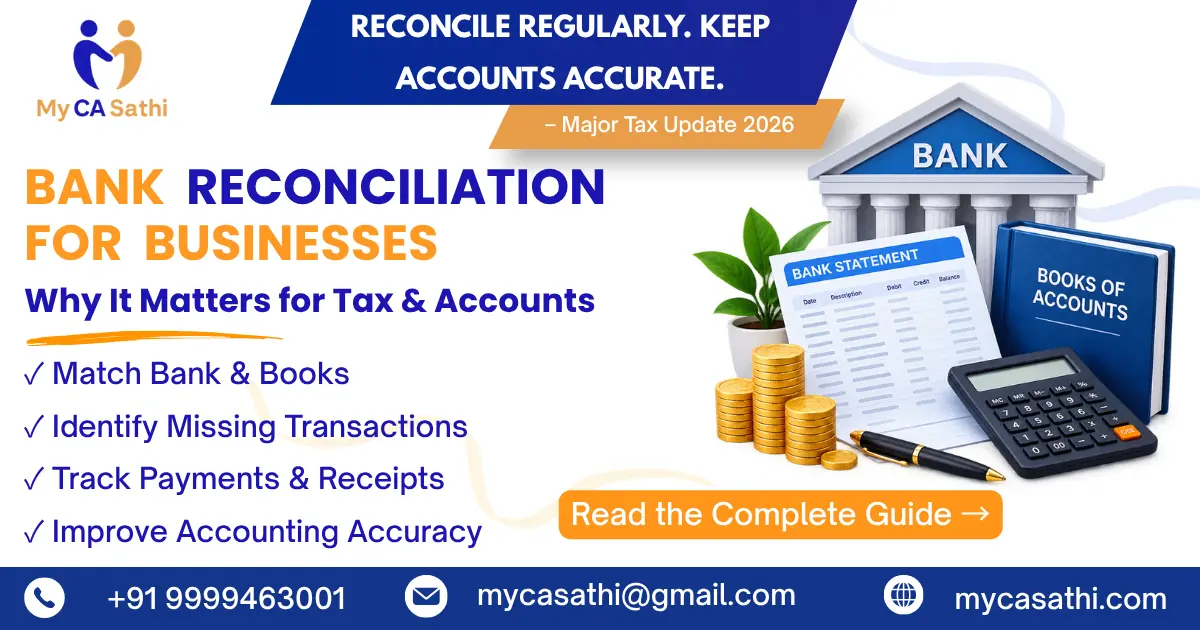
A business may have hundreds or thousands of transactions moving through its bank accounts during the year. Customer receipts, supplier payments, salaries, loan instalments, bank charges, interest and other transactions all need to be correctly reflected in the accounting records.
Simply recording transactions in accounting software is not always enough. Businesses should regularly compare their bank statements with their books of accounts to identify differences and ensure that the financial records accurately reflect actual transactions.
This process is known as bank reconciliation.
For businesses, bank reconciliation is useful not only for accounting accuracy but also for reviewing tax-related records, identifying missing transactions and preparing reliable financial information.
The Income Tax Department itself lists bank statements among documents taxpayers may need to keep ready for filing and verification purposes.
What Is Bank Reconciliation?
Bank reconciliation is the process of comparing:
Bank Statement ↔ Books of Accounts
The objective is to identify and explain differences between the balance shown by the bank and the balance recorded in the business's accounting system.
For example, a business's accounting software may show a bank balance of ₹8,50,000 while the bank statement shows ₹8,42,500.
This does not automatically mean that there is an accounting error.
The difference could be due to:
- Cheques issued but not yet cleared
- Deposits recorded in books but not yet credited by the bank
- Bank charges not recorded in books
- Interest credited by the bank
- Direct payments or receipts
- Standing instructions
- UPI or payment gateway settlements
- Timing differences
- Accounting errors
Bank reconciliation helps determine the actual reason for the difference.
Why Is Bank Reconciliation Important for Businesses?
1. Helps Maintain Accurate Accounting Records
Bank transactions provide an important source of evidence for the movement of business funds.
Regular reconciliation helps businesses identify transactions that may have been missed, incorrectly recorded or duplicated in the books.
This can improve the accuracy of:
- Cash and bank balances
- Income records
- Expense records
- Receivables
- Payables
- Financial statements
2. Helps Identify Missing Transactions
Sometimes a transaction appears in the bank statement but has not yet been recorded in the accounting software.
Examples include:
- Bank charges
- Interest income
- Direct debit payments
- Loan instalments
- Auto-debit subscriptions
- Customer receipts
- Payment gateway settlements
If these transactions are not recorded, the books may not reflect the actual financial position of the business.
3. Helps Detect Duplicate Entries
A transaction may accidentally be entered twice in accounting software.
For example:
A supplier payment of ₹25,000 may be recorded twice even though the bank account was actually debited only once.
Bank reconciliation can help identify such differences.
4. Helps Identify Accounting Errors
Errors can occur during day-to-day bookkeeping.
Examples include:
- Incorrect amount entered
- Wrong transaction date
- Incorrect bank account selected
- Payment recorded against the wrong supplier
- Receipt posted to the wrong customer
- Duplicate entry
- Reversal not recorded
Regular reconciliation provides an opportunity to detect and correct such issues.
How Does Bank Reconciliation Work?
A typical bank reconciliation process involves the following steps.
Step 1: Obtain the Bank Statement
Download the bank statement for the relevant period.
The statement should cover the same period for which the accounting records are being reviewed.
Step 2: Compare Bank Transactions With Books
Match each bank transaction with the corresponding entry in the accounting system.
For example:
| Bank Statement | Books |
|---|---|
| Customer receipt | Sales/receivable entry |
| Supplier payment | Purchase/payable entry |
| Bank charges | Bank expense |
| Interest received | Interest income |
| Loan EMI | Loan/interest entry |
Step 3: Identify Differences
Prepare a list of transactions that appear in one record but not the other.
These differences should then be investigated.
Step 4: Record Missing Entries
Where a legitimate bank transaction has not been recorded in the books, the appropriate accounting entry should be passed.
For example:
Bank charges appearing in statement but missing in books → Record bank charges.
Step 5: Investigate Timing Differences
Some differences are simply due to the timing of transactions.
For example:
A cheque may have been issued and recorded in the books on 28 September, but the cheque may be cleared by the bank only on 2 October.
The difference is therefore a timing issue rather than an accounting error.
Step 6: Complete the Reconciliation
After necessary corrections and explanations, the reconciled balance should agree with the bank statement after considering legitimate outstanding items.
Common Reasons for Bank Reconciliation Differences
Businesses commonly encounter the following differences:
Cheques Issued but Not Cleared
The business has recorded the payment, but the cheque has not yet been presented or cleared.
Deposits in Transit
A receipt has been recorded in the books, but the amount has not yet appeared in the bank statement.
Bank Charges
Banks may deduct charges that have not yet been entered into the accounting system.
Interest Income
The bank may credit interest directly into the account.
Direct Debits
Payments for loans, subscriptions, insurance or other services may be automatically deducted.
Payment Gateway Settlements
The accounting records may show gross customer collections while the bank receives a net settlement after fees or other adjustments.
UPI Transactions
Multiple UPI receipts or payments may require matching with individual accounting entries.
Errors in Bookkeeping
Incorrect amounts, duplicate entries or transactions posted to the wrong account can create differences.
Bank Reconciliation and Tax Compliance
Bank reconciliation is not itself a tax return requirement for every business. However, maintaining accurate and properly supported books is important for businesses subject to applicable accounting and tax requirements.
The Income Tax Department requires books and records in specified circumstances, and bank statements can form part of the documentation used to support financial information.
For businesses subject to tax audit, maintaining reliable books and identifying discrepancies is particularly important. The Income Tax Department describes tax audit as involving examination of the correctness of books and prescribed information.
Therefore, regular bank reconciliation can form an important part of a broader accounting-control process.
Bank Reconciliation and GST Records
GST-registered businesses maintain various records relating to purchases, sales, invoices, payments and other transactions.
CBIC's accounts and records rules require registered persons to maintain specified accounts and documents, including invoices, credit notes, debit notes, payment vouchers and other relevant records. The rules also provide for electronic record maintenance and audit trails.
Bank reconciliation can help businesses cross-check payment-related transactions against their accounting and GST records.
For example, a business may compare:
Purchase Invoice → Accounting Entry → Payment → Bank Statement
Similarly:
Sales Invoice → Customer Receipt → Bank Statement → Accounts Receivable
This can help identify transactions that need further review.
Bank Reconciliation for TDS-Related Transactions
Businesses making payments subject to TDS may need to track the underlying expense, payment, TDS deduction and related accounting entries.
Bank reconciliation can help identify payments that have actually moved through the bank account and compare them with the accounting records.
However, bank reconciliation alone does not replace the separate TDS compliance and reconciliation process.
Businesses should also review applicable TDS records, challans, statements and certificates as relevant.
Bank Reconciliation for Accounts Receivable
Bank reconciliation can help businesses track customer collections.
Suppose the books show:
Customer A – Outstanding: ₹1,00,000
The bank statement may show a receipt of ₹98,000.
The difference could be due to:
- TDS deduction
- Bank/payment gateway charges
- Partial payment
- Short payment
- Other adjustment
Instead of simply marking the invoice as fully paid, the business should investigate the difference and record it appropriately.
Bank Reconciliation for Accounts Payable
The same principle applies to supplier payments.
For example:
Supplier Invoice: ₹50,000
Bank Payment: ₹49,000
The business should determine why the payment differs from the invoice.
Possible reasons could include:
- TDS deduction
- Credit note
- Adjustment
- Partial payment
- Other agreed deduction
This helps maintain more accurate supplier balances.
How Often Should Businesses Perform Bank Reconciliation?
The appropriate frequency depends on the volume and nature of transactions.
Small Businesses
Monthly reconciliation may be practical where transaction volume is relatively low.
Growing Businesses
Businesses with regular customer receipts and supplier payments may benefit from weekly reconciliation.
High-Volume Businesses
Businesses handling large numbers of daily transactions may require more frequent or automated reconciliation.
The important principle is to avoid allowing unreconciled transactions to accumulate for long periods.
Monthly Bank Reconciliation Checklist
Businesses can use the following checklist:
☐ Download the bank statement
☐ Match opening balance
☐ Match customer receipts
☐ Match supplier payments
☐ Check salary payments
☐ Check loan instalments
☐ Identify bank charges
☐ Check interest credits
☐ Review UPI transactions
☐ Review payment gateway settlements
☐ Identify outstanding cheques
☐ Check deposits in transit
☐ Investigate unusual transactions
☐ Correct accounting errors
☐ Record missing bank transactions
☐ Finalise the reconciliation
Common Bank Reconciliation Mistakes
1. Reconciling Only at Year-End
Waiting until the end of the financial year can make it difficult to identify the reason for old differences.
2. Ignoring Small Differences
Small unexplained differences can accumulate and eventually create larger reconciliation problems.
3. Not Recording Bank Charges
Bank charges are sometimes missed because they are automatically deducted from the account.
4. Ignoring Direct Debits
Recurring subscriptions, loan payments and other automatic transactions may not be recorded immediately.
5. Mixing Personal and Business Transactions
Using business bank accounts for personal transactions can make reconciliation and financial reporting more complicated.
6. Not Investigating Old Outstanding Items
Old unreconciled cheques or deposits should be reviewed rather than carried forward indefinitely.
How Technology Can Make Bank Reconciliation Easier
Accounting software and banking integrations can reduce manual work.
Businesses can use technology to:
- Import bank transactions
- Match transactions automatically
- Identify unmatched entries
- Categorise expenses
- Track customer receipts
- Track supplier payments
- Generate reconciliation reports
- Maintain transaction history
However, automated matching should still be reviewed. A software-generated match does not necessarily mean that the accounting treatment is correct.
Bank Reconciliation and Financial Statements
Accurate bank balances are important when preparing financial statements.
Unreconciled bank transactions may affect:
- Cash and bank balances
- Profit and loss reporting
- Receivables
- Payables
- Expenses
- Interest income
- Loan balances
Regular reconciliation therefore supports the preparation of more reliable financial information.
What Records Should Businesses Keep?
Businesses should maintain appropriate supporting records for their bank reconciliation process, such as:
- Bank statements
- Bank reconciliation statements
- Payment records
- Deposit records
- Cheque details
- Bank advice
- Loan statements
- Interest certificates
- Payment gateway reports
- Relevant accounting entries
- Supporting invoices and receipts
Where records are maintained electronically, businesses should have appropriate backup and retrieval procedures. GST rules specifically provide for electronic backups and the ability to produce relevant records when required.
Benefits of Regular Bank Reconciliation
A consistent reconciliation process can help businesses:
Improve Accounting Accuracy
Identify missing and incorrect entries.
Improve Cash Visibility
Understand the actual movement of business funds.
Support Tax Reporting
Provide better-quality financial information for tax computation and reporting.
Identify Errors Early
Detect duplicate, missing or incorrect transactions.
Strengthen Internal Controls
Create a regular review process for financial transactions.
Simplify Year-End Closing
Reduce the number of unresolved transactions at the end of the year.
Final Takeaway
Bank reconciliation for businesses is an important accounting control that helps connect the business's bank activity with its books of accounts.
It can help identify missing transactions, timing differences, duplicate entries, bank charges and accounting errors. It can also support the preparation and review of financial information used for tax, GST and other compliance processes.
Businesses should avoid treating reconciliation as a year-end activity. A regular monthly or more frequent reconciliation process, depending on transaction volume, can make financial records easier to review and maintain.
Accurate books start with accurate transaction records—and regular bank reconciliation helps keep those records aligned with actual bank activity.
Key Takeaways
- GST registration requirements depend on turnover and nature of business.
- Timely filing helps avoid unnecessary interest and late fees.
- Businesses should maintain proper invoices and supporting documents.
Important Note
Tax rules and compliance requirements may change from time to time. Always verify the applicable provisions before taking any action.